
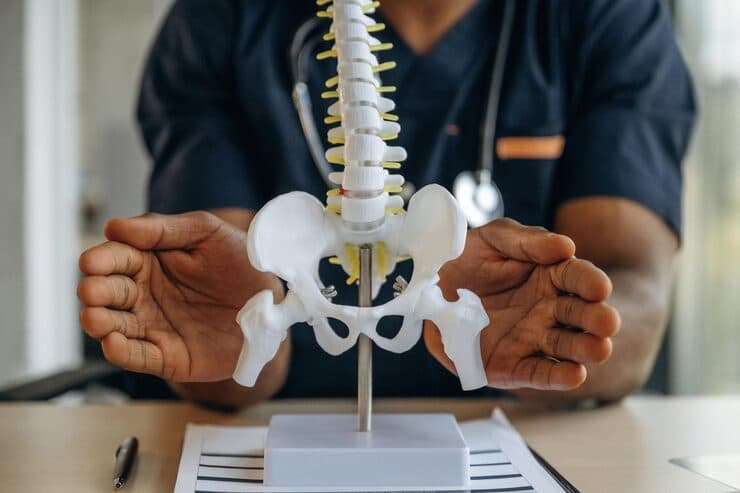

Understanding Robotic Hip Replacement
Avascular necrosis (AVN) of the femoral head, severe osteoarthritis, ankylosing spondylitis, dysplastic hip, and post-traumatic arthritis can destroy the hip's natural ball-and-socket mechanism. Robotic total hip arthroplasty provides real-time biomechanical analysis to accurately place the acetabular cup and femoral stem, matching the patient's individual spino-pelvic dynamics and minimizing the risk of post-operative impingement or dislocation.
The Robotic Arthroplasty Advantage
Unlike traditional manual joint replacements that rely on generic cutting blocks, robotic assistance provides a customized virtual 3D CT model of your specific bone geometry, enabling the surgeon to preserve healthy native bone and maintain balanced ligament tension throughout full motion.
When Should You Consider Consultation for Robotic Hip Replacement?
Specialist intervention is considered when joint pain or functional limitation significantly disrupts your daily life and conservative measures have been exhausted. Check if you experience any of the following:
Deep groin pain or pain radiating to the thigh and knee during weight-bearing.
Difficulty putting on shoes, socks, or cutting toenails due to hip stiffness.
Noticeable limp or sensation of limb length discrepancy.
Radiological diagnosis of Avascular Necrosis (AVN) of the femoral head.
Pain that interferes with sleeping when lying on the affected hip.

Dr. Vijay Kumar
Verified SpecialistSenior Consultant Orthopaedic, Robotic Joint Replacement & Complex Articular Trauma Surgeon
“Every robotic joint replacement is planned on a high-precision 3D digital model of your natural limb alignment. This constitutional balancing ensures that native collateral ligaments remain relaxed and intact, delivering a natural, pain-free walking sensation from day one.”
Robotic vs Conventional Joint Arthroplasty
See how sub-millimetre robotic technology transforms surgical precision, safety, and recovery compared to standard manual surgery:
| Clinical Parameter | ✨ Advanced Robotic Arthroplasty | Conventional Manual Surgery |
|---|---|---|
| 3D Pre-Operative Planning | CT-guided 3D digital virtual model matches patient-specific anatomy | 2D static X-ray estimates with standard sizing charts |
| Bone Resection Precision | Sub-millimetre (0.5 mm) accuracy governed by robotic haptic arm | Manual cutting blocks with potential alignment variance |
| Soft-Tissue & Ligament Balancing | Real-time dynamic sensors verify tension through full arc of motion | Subjective surgeon manual feel with gap-spacer blocks |
| Safety & Boundary Protection | Haptic boundary limits automatically prevent saw damage to vessels | Relies solely on manual retractor placement and surgeon sight |
| Post-Operative Ambulation | Same-day or 24-hour assisted walking with minimal tissue trauma | 2 to 4 days bed rest before initiating full weight-bearing |
| Implant Longevity & Natural Feel | Constitutional alignment optimizes wear distribution for 25+ years | Mechanical axis alignment may feel stiffer to some patients |
The 4-Stage Precision Clinical Workflow
3D Virtual Anatomical Pre-Plan
Patient-specific 3D pelvic scan analysis to evaluate functional pelvic tilt and bone density.
Dynamic Intraoperative Kinematic Mapping
Digital verification of femoral offset, leg length, and centre of rotation.
Haptic Robotic Arm Execution
Robotic reaming of the acetabulum within safety boundaries to preserve vital pelvic bone.
Biocompatible Implant Seating & Fast Mobilization
Implantation of advanced ceramic-on-crosslinked polyethylene bearings for ultra-low wear.
Treatment Modalities Offered
Dr. Vijay Kumar practices conservative joint-sparing protocols first, proceeding to advanced surgical intervention only when indicated:
Non-Surgical & Joint Sparing
- Protected weight-bearing and crutch mobilization in early-stage AVN
- Medications for bone turnover and anti-inflammatory relief
- Physical therapy focusing on core and hip abductor strength
- Core decompression for pre-collapse stages of femoral head necrosis
Specialised Surgical Procedures
- Robotic Total Hip Arthroplasty (THA)
- Minimally invasive anterior or posterior hip approach
- Complex primary hip reconstruction for developmental dysplasia (DDH)
- Revision Total Hip Replacement
Recovery Timeline & Mobility Milestones
Day 1: Ambulation with walker or crutches with physiotherapist assistance.
Week 2: Suture/staple removal, transition to single cane or unassisted indoor walking.
Week 6: Resumption of regular office work, driving, and low-impact recreational activities.
Month 3: Full restoration of gait and endurance without limp.
International Fellowship & Surgical Suite Records
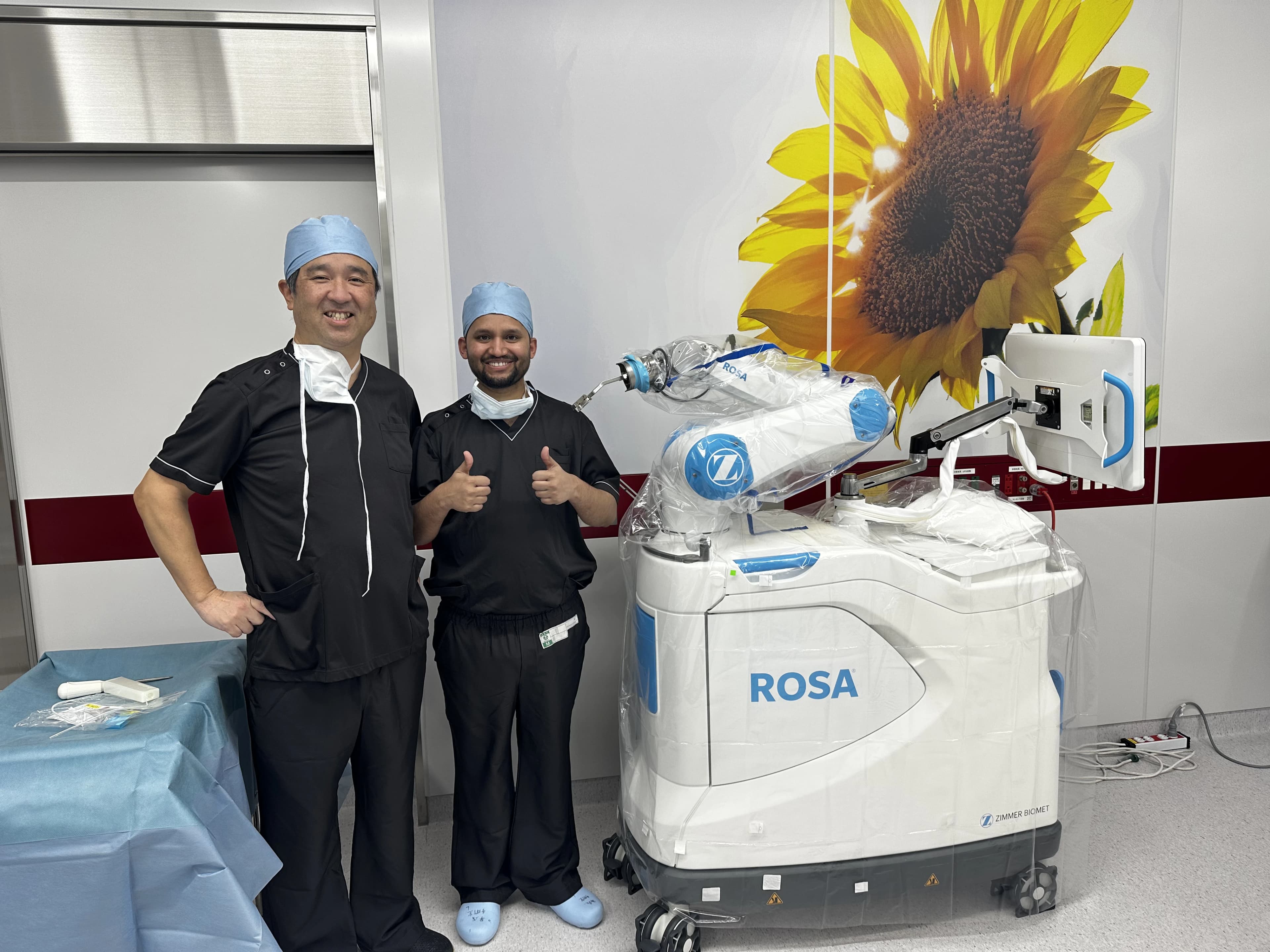
Intraoperative kinematics & 3D navigation alongside Japanese surgical faculty.
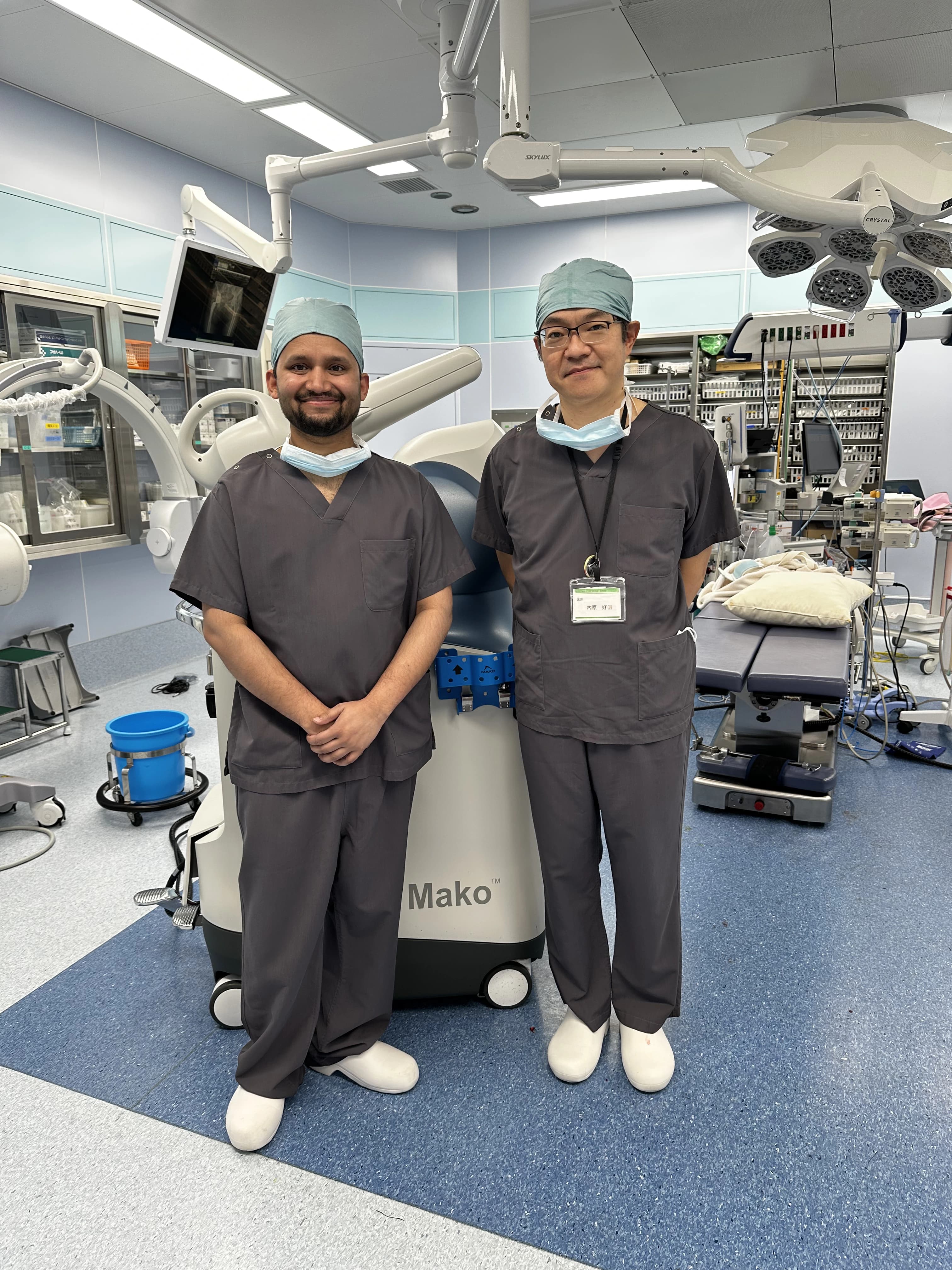
International fellowship-level precision applied to patient care in Patna.
Frequently Asked Questions on Robotic Hip Replacement
Robotic hip replacement combines preoperative 3D imaging with real-time robotic guidance during surgery. It allows the surgeon to ream the acetabulum and position the prosthetic socket with precise angles tailored to your specific pelvic mechanics.